Child-Height Touchpoints
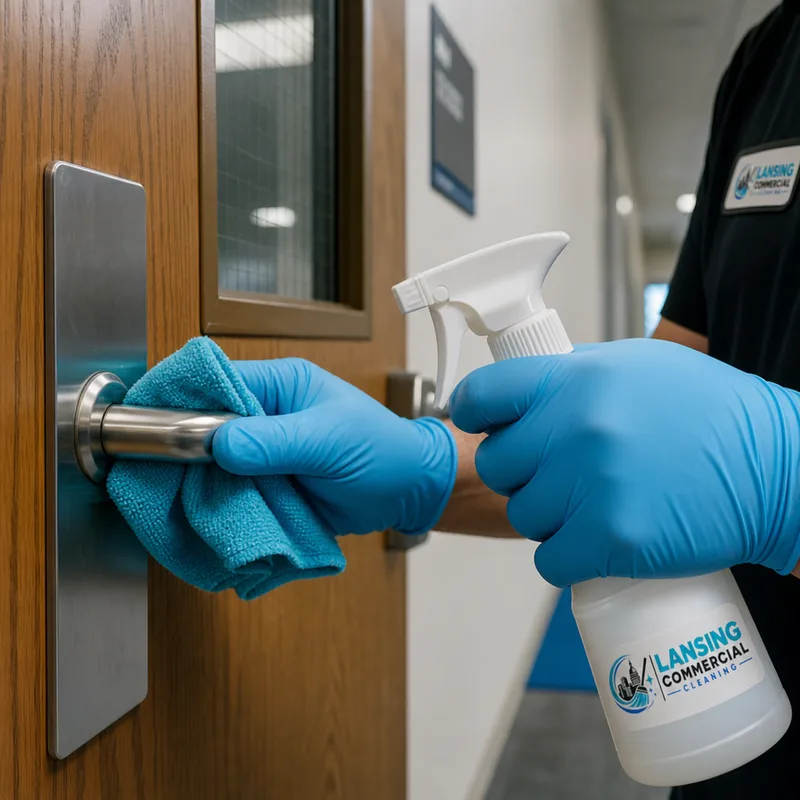
Table edges, chair backs, door pushes, cubby fronts and low handles are treated as their own pass, since an adult-height routine misses them.
Serving Lansing, Michigan & surrounding areas
Mon–Fri 8am–6pm Sat 9am–2pm
Classrooms And Halls
Schools and daycares put a great many hands on a small number of surfaces, and they do it on a timetable that cannot move. Classrooms, cafeterias, restrooms and corridors are what we cover for education and childcare buildings around Lansing. The work runs after dismissal, with heavier projects saved for breaks.
Volume And Height
Two things set a school apart from an office of similar size. The first is restroom volume, because a hundred children use a facility in minutes rather than across a day, so fixtures, floors and dispensers take concentrated load at fixed hours. The second is surface height: in a daycare or lower-year classroom the busiest touchpoints sit low down, on table edges, chair backs, door pushes, cubby fronts and toy storage, a band an adult-height routine skips entirely. Add floors that take craft materials, food and outdoor grit, and the cleaning plan has to follow the way the building is really used.
Through The Building
Classrooms take desks and table tops, chair backs and legs, low touchpoints, sinks where fitted, floors and the edges around cubbies and storage. Restrooms are serviced on every visit, with fixtures, partitions, dispensers, hardware and floors, plus restocking from your stores or ours. Cafeterias and dining halls cover tables, bench seating, serving counter exteriors, floors and the spill zones under seating. Corridors, stairwells, entry areas and gymnasium floors carry grit from outside and need frequent passes. Offices, staff rooms and libraries finish the round, and play areas and nap rooms are written in where a daycare has them.
Every Visit
What this covers in practice, from child-height touchpoints, restrooms at scale through the rest of the list below, each with the detail that matters on site.
Table edges, chair backs, door pushes, cubby fronts and low handles are treated as their own pass, since an adult-height routine misses them.
Facilities are serviced every visit and restocked, because concentrated use at fixed hours empties dispensers far faster than steady traffic does.
Tables, bench seating, counter exteriors and the floor under seating are cleaned after service so the hall is ready for the next sitting.
Floors are vacuumed or mopped with attention to craft debris, food and the grit tracked in from play areas and buses.
High-traffic routes, stair treads, handrails and entry matting get regular passes because this is where outdoor soil spreads from.
Floor restoration, high-level dusting and detailed room resets are scheduled into breaks when rooms are finally empty.
Whoever manages the building takes us round, and we record room counts, restroom numbers, floor types and any area your own staff keep.
Service times are set around dismissal and activities. Entry, sign-in, badge and any supervision requirements your site applies are agreed before the first visit.
Classrooms, restrooms, corridors and dining areas are covered to the written frequency, with low touchpoints taken on every visit.
Heavier work waits for closures. Floor stripping, high dusting and deep resets land in breaks rather than disrupting a teaching week.
A supervisor reviews the written list on rotation and flags anything needing attention, such as a restroom running through consumables faster than planned.
What Moves It
The bands published on this site are about $150 to $600+ per visit for small to mid-size premises and roughly $0.10 to $0.25 per square foot per visit, with smaller sites often near $200 to $700 per month depending on frequency. A daycare or small school usually reads like a building at the upper end of its size band, because restroom volume and low-touchpoint work both add labor. Room count, restroom numbers, floor types, service days per week and whether break projects are included move it further. Scope and figure are confirmed in writing after the walk.
Sites We Cover
We serve schools, preschools and childcare settings in Lansing, East Lansing, Charlotte, Mason, Grand Ledge and DeWitt. Being based on South Hosmer Street keeps crews close enough to arrive soon after dismissal, which is the window most sites want used. Small childcare homes, standalone daycare centers, preschool rooms inside larger buildings and full school sites all work from the same written approach, scaled to room and restroom counts. Where an operator runs several settings, one written standard across them keeps the routine recognizable to any manager covering more than one location during a staff absence.
A short orientation to this section before the detail below.
Questions From Sites
Answers to what buildings ask before they arrange a walkthrough, covering scope, scheduling and how the work gets checked.
After dismissal is standard, once classrooms and corridors are clear. Where after-school activities run late, we work the rooms that are free and return to the rest in sequence. Some sites prefer an early-morning crew before arrival, which suits the same written task list equally well.
Yes, and it is written in as its own pass. Table edges, chair backs, door pushes, cubby fronts and low handles carry most of the hand contact in a daycare or lower-year classroom, and an adult-height routine walks straight past them. Treating that band separately is the point.
Restrooms are serviced on every visit rather than on a rotation, because a hundred users in a few minutes empties dispensers and loads floors in a way steady traffic never does. Restocking happens on the same visit, drawing on your cupboard or on stock the crew brings.
That is the sensible place for it. Floor stripping and refinishing, high-level dusting and full room resets all need rooms empty and undisturbed cure or drying time, so they are scheduled into term breaks and closure days rather than squeezed into a teaching week.
Whatever your site requires is what the visit follows. Sign-in procedures, badges, supervision rules and any restricted areas all get recorded before the first service, so a crew arrives already knowing your safeguarding process rather than improvising at the door and asking staff to vouch for them.
Either way works. Plenty of sites prefer purchasing paper and soap themselves and having crews refill from the cupboard, which keeps grades and budgets in house. Others would rather it all turned up with the crew. Say which at the walk and the list records it.
Plan your service
Dial (517) 272-8424 and we will tour the site with whoever manages the building. What comes back is a documented task list and a cost matched to your room and restroom counts.
Tell us about the building and the areas that matter most, and we will arrange a walkthrough and a written scope.
Request a quote
Send the building type, the areas that matter most and your preferred service window, and we will follow up to arrange a walkthrough.